Archive of Work
Edited Books
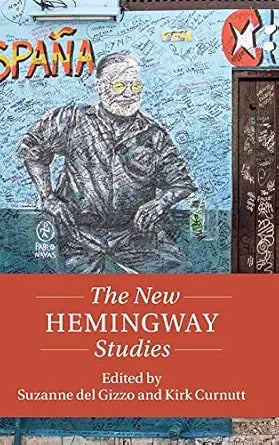
The New Hemingway Studies
Edited by Suzanne del Gizzo and Kirk Curnutt. Cambridge UP, 2020.
Love him or hate him, Ernest Hemingway endures both in American popular culture and in literary studies. The subject of endless biographies, fictional depictions, and contentious critical debate, he remains both the definitive stylist of twentieth-century literature, a case study in what happens to an artist consumed by the spectacle of celebrity, and a hot property whose name marketers eagerly capitalize upon. The New Hemingway Studies examines how two decades of new-millennium scholarship confirm his continued relevance to an era that, on the surface, appears so distinct from his—a contemporary vista defined by digital realms, ecological anxiety, and globalization. Highlighting the latest critical trends while pointing out paths yet taken, the contributors to this volume dramatize how Hemingway’s remarkably durable stories, novels, and essays have served as a lens for understanding preeminent concerns in our own time, from paranoia to pleasure, trauma to iconicity, from fixed roles in the family romance to the porousness of racial, sexual, and national identities. Read our blog post about the book on Cambridge’s 1584.
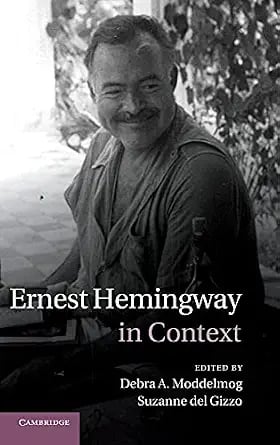
Ernest Hemingway in Context
Edited by Debra A. Moddelmog and Suzanne del Gizzo. Cambridge UP, 2013.
Ernest Hemingway’s literary career was shaped by the remarkable contexts in which he lived, from the streets of suburban Chicago to the shores of the Caribbean islands, to the battlefields of World War I, Franco’s Spain, and World War II. This volume examines the various geographic, political, social, and literary contexts through which Hemingway crystallized his unmistakable narrative voice. Written by forty-four experts in Hemingway Studies, the comprehensive yet concise essays collected here explore how Hemingway is both a produce and a critic of his times, toughing on his relationship to matters of style, biography, letters, cinema, the arts, music, masculinity, sexuality, the environments, ethnicity and race, legacy, and women, among other topics. Fans, students, and scholars of Hemingway will turn to this reference time and again for a fuller understanding of this iconic American author.
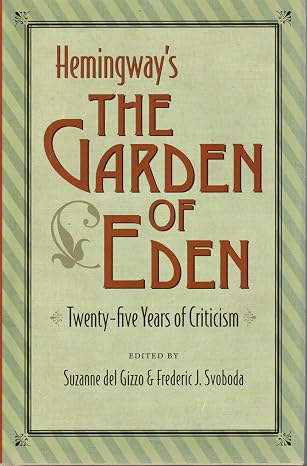
Hemingway's The Garden of Eden: Twenty-Five Years of Criticism
Edited by Suzanne del Gizzo and Frederic J. Svoboda. Kent State UP, 2012
When The Garden of Eden appeared in 1986, roughly twenty-five years after Ernest Hemingway s death, it was a watershed event that changed readers' and scholars' perceptions of the famous American author. Following five months in the life of protagonist David Bourne, a rising young writer of fiction, and his highly intelligent but artistically frustrated wife, Catherine, the novel is unique among Hemingway's works. Its exploration of gender roles and identities, unconventional sexual practices, race, and artistic expression challenged the traditional notions scholars and readers had of the iconic writer, and it sparked a debate that has revolutionized Hemingway studies.
In Hemingway's The Garden of Eden: Twenty-Five Years of Criticism, editors Suzanne del Gizzo and Frederic J. Svoboda have collected the best essays and reviews pieces that examine the novel's themes, its composition and structure, and the complex issue of editing a manuscript for posthumous publication and placed them in a single, cohesive volume.
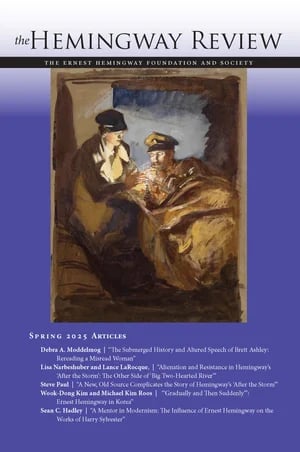
The Hemingway Review, edited by Suzanne del Gizzo, is a scholarly journal published twice a year by The Ernest Hemingway Foundation and Society. The journal specializes in researched scholarship on the work and life of Ernest Hemingway.
The Hemingway Review has a print run of 700 copies. Copies are sent to contributors, members of the Hemingway Society, and libraries. The Review also enjoys unlimited circulation via electronic databases including Project Muse (Johns Hopkins University Press), Ebsco Host, and ProQuest. Collectively, these resources make the journal almost universally available in high school, public, and academic libraries.
The Review welcomes all critical approaches from traditional to cutting edge. The journal does not ordinarily publish fiction, poetry, or other writing that is not researched scholarship.
We expect the articles we publish to show a wide familiarity with and to demonstrate a significant departure from or modification of existing Hemingway criticism. To enhance your chances for acceptance, we suggest that you familiarize yourself with the wide spectrum of Hemingway scholarship, particularly with work already published in The Review.
The Hemingway Review values and publishes writing that is technically correct and stylistically graceful. We believe that academic prose should be enjoyable to read and crystal clear.
For more information about publishing in THR, visit the submission guidelines page on the Hemingway Society website.
14 issues
Since 2014